
Designing a custom display stand isn’t about picking a colour scheme and choosing where the brand logo goes. It’s a project that runs from a blank page through structural drawings, material specs, venue compliance, a freight schedule, and ends with a finished stand on a trade show floor in front of your customers.
This piece walks through how to design a custom display stand from first conversation to installation, what each stage of bespoke stand design involves, and where most projects gain or lose time. If you’re looking for a closer look at how to design a custom display stand for a major trade event, the steps below cover the full process. For more on AEH’s full custom build capability, you can also visit the Custom Displays Australia page.
Step 1: Start with a Real Brief
Every custom exhibition stand design starts with the same thing: a clear brief. What’s the event, the floor space and the build window? Who are you trying to reach, and how do you want them to interact once they’re there? Is the goal lead generation, product launch, brand awareness, or a mix? What’s the budget range, and is the stand being designed for one trade event or reused across several?
The brief also needs to cover the constraints. Brand standards, must-have features (meeting room, demo screen, storage), venue rules, and any compliance requirements specific to your industry. Pharmaceutical exhibitors have MA Code restrictions. Mining, defence, and government work have their own security considerations. The earlier these considerations are on the table, the easier it is to design around them. Knowing how to design a custom display stand around real-world brand and venue constraints is what separates a good exhibition stand design from one that looks great but can’t be built.
Step 2: Concept and Creative Response
Once the brief is agreed upon, the design team takes it away and comes back with a creative response. Most experienced display stand builders treat exhibition stand design as a multi-disciplinary exercise.
Industrial designers handle the structural thinking, in partnership with the project manager and operations and signage teams. Consideration is taken of how the stand sits in the space, the structural integrity of the stand, how visitors will interact with the stand, and what substrates and signage types will work best on each stand.
You’ll usually see a 3D concept first, with rendered views of the display with materials called out and key features highlighted. Expect to give feedback at this stage. Two or three rounds of revisions are normal. More than that usually means the brief wasn’t tight enough at Step 1 and will likely incur additional design fees.
Step 3: Sign-Off and Technical Build Plans
Once the 3D concept is approved, the project moves into technical drawings. This is the unglamorous but critical stage of the custom exhibition stand design process, where every panel, joint, fixing, light and graphic gets specified. The render becomes a set of construction documents that the workshop can build from.
Early 3D render and proposal sign-off matters! A typical custom 3D design and proposal needs sign-off twelve weeks before the event. That allows time for build plans to be created and issued to operations, materials to be ordered, graphics to go to print, and pre-assembly to happen before freight goes out. Late changes after sign-off are where the budgets can blow up, as a single-dimensional change can cascade through structural drawings, freight crating, install schedules and venue compliance.
Step 4: Materials, Sustainability, and Build Quality
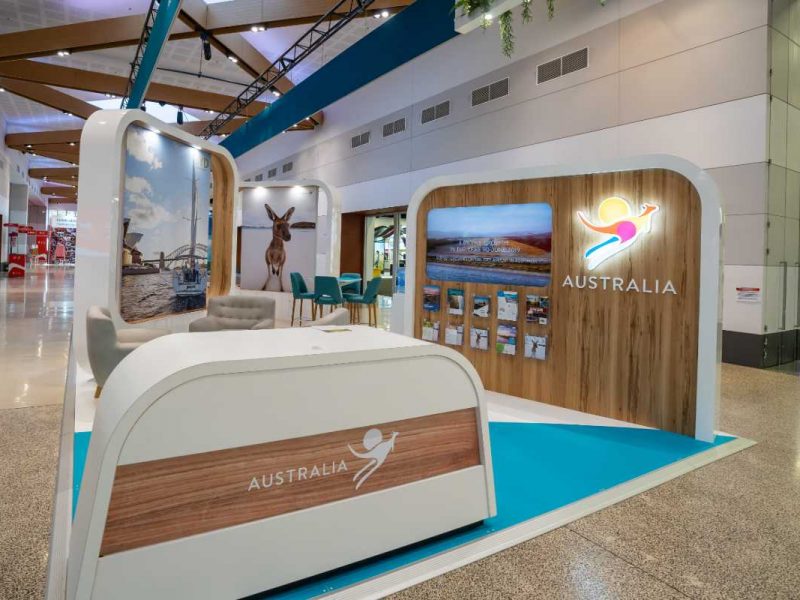
Material selection is part design decision and part engineering decision. The custom stand needs to look the way the brand wants it to look, and withstand freight, repeated assembly and the wear of an active trade show floor.
Most premium builds use a combination of timber framing, high-density board, fabric tension panels, acrylic and powder-coated metal. Each does a different job. Timber and ply for structural elements, fabric for clean large-format graphics, acrylic for product showcases, and metal for anything load-bearing.
Sustainability has shifted from a nice-to-have to a real procurement question. Eco Board (a fully recyclable substrate) is increasingly the default for graphics walls and partitions. AEH’s sustainability work has been recognised on projects like evokeAG, where 95% of building and signage materials were reused or recycled.
Build quality also depends heavily on where production happens. In-house manufacturing for cabinet makers, shopfitters and signage finishers under the same roof means the team designing the stand is the same team building it.
Step 5: Pre-Assembly and Quality Checking
Before any custom exhibition stand goes near a venue, it should be pre-assembled in the workshop. Every panel, joint and fixture checked. Every graphic is test-fitted. A misaligned joint discovered in the warehouse is a thirty-minute fix. The same joint discovered during a six-hour installation window is a much bigger problem. Good exhibition stand builders for custom displays treat pre-assembly as standard practice, not an extra.
Step 6: Freight, Installation and Bump-In
The custom exhibition stand design process doesn’t end at the workshop door. Getting the stand into a trade show venue (whether that’s the ICC in Sydney, MCEC in Melbourne, BCEC in Brisbane or any of the regional convention centres) involves freight, venue compliance, install crews and Work Health and Safety documentation.
Each venue has its own rules: bump-in windows, dock access, loading restrictions, height limits, and electrical compliance. Stands are crated, freighted, unloaded, assembled on-site, finished, lit and handed over before the show opens. The best version of this process is invisible: you arrive at your stand, it looks the way it looked in the renders, and it works.
Step 7: On-Site Support, Dismantle and Storage
The job isn’t done when the stand opens. Most custom builds include on-site support throughout the event to ensure someone is available to handle minor repairs or AV issues. Dismantle is its own piece of work. For modular stands designed for reuse, components are carefully packed for storage. Quality storage between events protects timber, graphics and electrical components from the wear that destroys cheaper builds.
Where Major Events Happen Across Australia
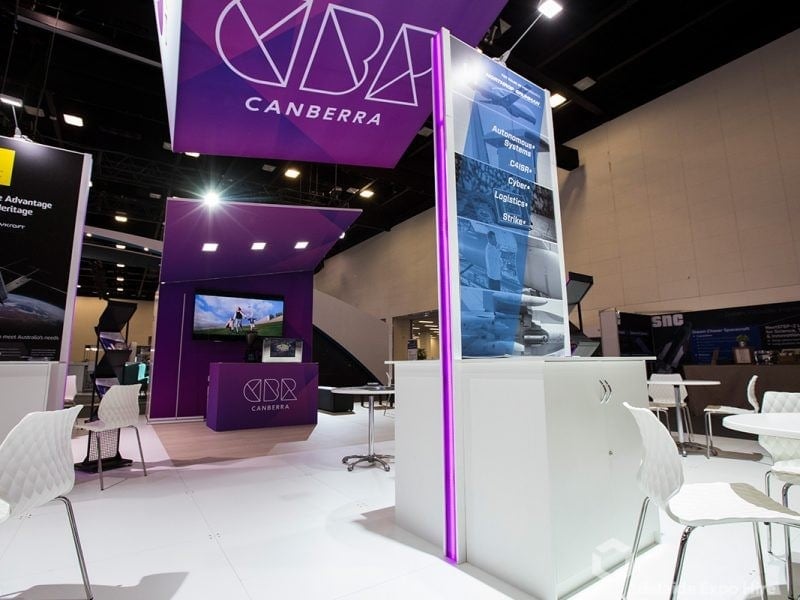
Custom exhibition stand work in Australia clusters around the major event venues. Sydney’s ICC, Melbourne‘s MCEC, Brisbane‘s BCEC, the Adelaide Convention Centre and Perth Convention Centre handle the majority of large national exhibitions. Experienced exhibition stand builders work nationally. The build happens in one location, and install crews mobilise to wherever the event is.
For exhibitors planning a multi-event year (say, a brand launch in Sydney, a follow-up at a Melbourne expo, then a Brisbane trade show), the design needs to account for that early. A display stand designed properly for reuse can run all three.
Working with AEH
A quality exhibition stands design partner gives realistic timelines and sticks to them, shows you the build before it leaves the warehouse, and handles whatever goes sideways at the venue without making it your problem.
AEH has delivered custom exhibition stand work and exhibition stand design across Australia for over thirty years, with clients including Tourism Australia, Hii, Haleon, Caterpillar of Australia, The European Union and the International Astronautical Congress. Production is in-house, installation crews operate nationally, and the team holds memberships with IFES, ABEA and JOSCAR for clients with international or government compliance requirements. If you’re working out how to design a custom display stand for an upcoming brand activation, the AEH team is a good place to start the conversation.
→ Talk to AEH about your next custom stand
Frequently Asked Questions
How long does it take to design a custom exhibition stand?
For a major build, allow six months from first brief to event day. Sign-off on the design is required twelve weeks before delivery, with technical build plans issued to operations at least eight weeks out.
Can you reuse a custom exhibition stand at multiple events?
Yes – if it’s been designed for reuse from the start. Modular construction lets components be reconfigured for different floor plans across cities, and graphics can be reprinted between events.
What’s the difference between a custom and a portable exhibition display?
Portable exhibition display stands are pre-engineered systems (pop-ups, modular kits, tension fabric frames) designed for fast setup and easy transport. A custom exhibition stand is built specifically for your brand, space and goals. Bigger investment and a much bigger impact at major trade events.
Do you handle exhibition stand builds outside the major capital cities?
Yes. AEH work Australia-wide. Builds happen at the workshop, and install crews mobilise wherever the event is.
Ready to start the conversation?
Send through a brief, or get in touch for a no-pressure chat about what you’re trying to achieve.