
An Exhibition Strategy for Launch Day
- A product launch is the strongest case for a bespoke display, but the stand is the venue for the launch, not the launch itself. It needs an exhibition strategy.
- Choose the show based on who buys this product, and launch when you can ship.
- Build the display around the product: one message readable from the aisle, the product at eye level, and the demonstration built in. 75% of attendees prefer hands-on demos.
- Plan launch day in three zones: reveal and demo at the front, a conversation zone behind it, and a meeting space. Brief staff the night before and follow up within two working days post-event.
- Give the display a job after the launch: a graphics change takes it to the next show as part of the product’s exhibition strategy.
A product launch is the one event that justifies a bespoke display on its own. The buyers are already in the room, they came to see what is new, and a display built around the product gives it the floor to itself. What goes wrong is treating the stand as the launch. The stand is the venue for it. The launch needs an exhibition strategy: the right show, one message, a working demonstration, a staff brief, a follow-up plan and a job for the display after the reveal.
The audience is worth the effort. The Australian Business Events Association counted 19.8 million business event visitors in 2024, and Freeman’s 2024 Trends Report found 80% of attendees rate in-person events as their most trusted source of information. For a new product, that trust is the point.
Step 1: Choose the show where the buyers for this product are
An exhibition strategy for a launch starts with the show, not the stand. Ask the organiser for last year’s attendee breakdown by job title and company size, and look for the buyers of this product, not of your range in general. Check who else exhibits, because a launch next to your two biggest competitors is a comparison you have to win on the day.
Timing matters more than at any other show. Launch when you can ship. A product shown in March that cannot be delivered until September loses the momentum the show created. Work back from the show date: brief the display six months out, sign off the design twelve weeks before handover, and have final build plans with our operations team at least eight weeks out. That leaves time for the product itself to be final before the graphics are printed.
Step 2: Build the bespoke display around the product, not the brand
 On a launch stand, the product is the hero and the brand is the frame. Everything in the design serves one message: what this product changes for the person walking past. Visitors decide whether to stop in the time it takes to pass a 3 metre frontage, so the headline, the product name and one line on what it does need to be readable from the end of the aisle. That means height, open sightlines and lighting aimed at the product rather than the logo.
Put the product at eye level, working if it can be, and give it space. A bespoke display can build the demonstration in: power, water or data where the product needs them, a counter at the right height for someone to try it, and a screen beside it showing the result. Freeman’s research found 75% of attendees prefer demonstrations and hands-on activities over any other way of learning about a product at an event. For a launch, the demonstration is the launch.
If there is a launch hour, design for the reveal. Hinged or sliding panels, a cover that lifts, or a screen that switches from a countdown to the live product all give the moment a shape. When we start a custom display project at AEH, we ask what the product has to do on the stand before we draw anything.
Step 3: Plan the launch day inside the stand
A launch stand needs three zones. The reveal and demonstration at the front, where the crowd forms. A conversation zone a step back, where a buyer can sit for ten minutes and ask the questions they will not ask in a crowd. And a meeting space, even a small one, for the distributor or key account conversations that a launch brings. Lockable storage inside the structure keeps samples, stock and coats off the floor.
Fill the stand before the doors open. Invite your top customers and prospects to a set launch hour, list the product in the organiser’s new product showcase if there is one, and tell existing customers the show, the stand number and the time.
Brief the staff the night before. Everyone on the stand should be able to run the 90-second demonstration, answer the three questions a buyer will ask, and know the three questions that qualify a visitor. The lead scanner gives you a name; a note on what the person asked about is what makes the follow-up land. Then follow up within two working days, with the demonstration video for the people who asked for it and a meeting request for the ones who qualified.
Step 4: Measure the launch
Decide before the show what the launch has to produce, and give it a number you can count the Monday after. For most launches, the figures worth tracking are:
- Qualified demonstrations per day, logged by staff, not scanned badges
- Meetings held in the conversation zone, booked before and during the show
- Trial, sample or order requests taken on the stand
- Leads that reached a second conversation within 30 days
- Revenue attributed to the launch at six and twelve months
Step 5: Give the display a job after launch day
A launch is the start of the product’s exhibition strategy, not the end of it. A bespoke display designed for reuse carries the product to the next show with a graphics change and nothing else: the structure travels between venues, the headline moves from launch language to range language, and a modular design lets the same components work as a 3×3 event and a 6×6 at another. Every show after the first is freight, install and graphics, not a new build.
Plan those shows now. A display that will travel is checked against every venue on the calendar at the design stage. We cover venue-by-venue details on our convention centre locations, and the decision on whether a custom build suits in the first place in our post on how to know if a custom-built exhibition stand is right for your business.
How AEH builds a launch display
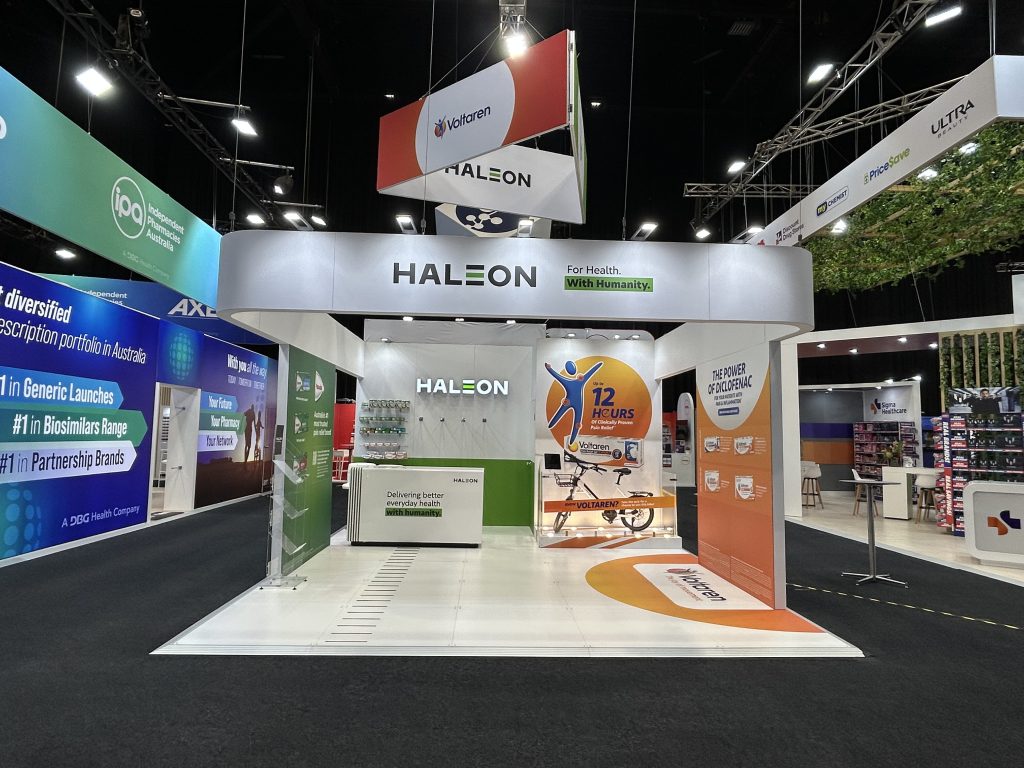 Call us on +61 8 8350 2300 with the show, your stand number and floor plan, the product and what you want visitors to do with it on the stand. Our industrial designers produce a 3D concept to enable you to visualise what the stand will look like on the event floor. The display is built in our own workshop by our cabinet makers, shopfitters and signage team, and we pre-build the stand and run quality checks in the workshop before it is packed, so launch day is the second time it works, not the first. Our own crew installs it, and the display comes back to the workshop ready for the next event.
AEH (formerly Adelaide Expo Hire) has designed, built and installed custom display stands for more than 30 years, holds IFES and Australian Business Events Association memberships, and is JOSCAR registered.
Frequently Asked Questions
How far ahead of the launch show should we brief the display?
About six months. Design sign-off is due twelve weeks before handover and final build plans go to our operations team at least eight weeks out. For a launch, the extra margin lets the product itself be finalised before the graphics are printed, and leaves time to test the demonstration on the pre-assembled display in our workshop.
Can we keep the product confidential until launch day?
Yes. The display is designed and pre-assembled inside our own workshop, graphics are printed last, and reveal panels or covers can be built into the structure so the product stays hidden on the floor until the launch hour. Tell us at the brief stage what has to stay confidential and we will plan the build around it.
What if the new product is software or a service?
The same exhibition strategy applies, the demonstration just changes shape: a screen running the live product or a touch screen where buyers can experience your product first-hand, a before-and-after case study wall, or a meeting space where a buyer can see their own numbers in it. The reveal can be a screen rather than a cover.
Can the launch display be used at the next show?
Yes, if it is designed for reuse from the start. We build modular custom displays where the same towers, counters and panels assemble as a 3×3, a 3×6 or a 6×6, with graphics sized to each layout. After the launch, the headline changes and the structure travels. We check each venue’s height limits and floor plan before the display moves.
If you have a product to launch next year, contact AEH on +61 8 8350 2300, and we will design the bespoke display and plan the show around it.
About the Author
AEH has been designing, building and installing exhibition and custom display stands for more than 30 years, and is a three-time inductee into the Meetings and Events Australia Hall of Fame
We manufacture in our own warehouse facility, which keeps quality control and build schedules in our hands, and we hold memberships with the International Federation of Exhibition and Event Services and the Australian Business Events Association, along with JOSCAR registration. Our designers, cabinet makers, shopfitters, signage technicians and project managers work as one team, so the people who design your stand are the people who manufacture it, apply the signage and install it at the venue.